


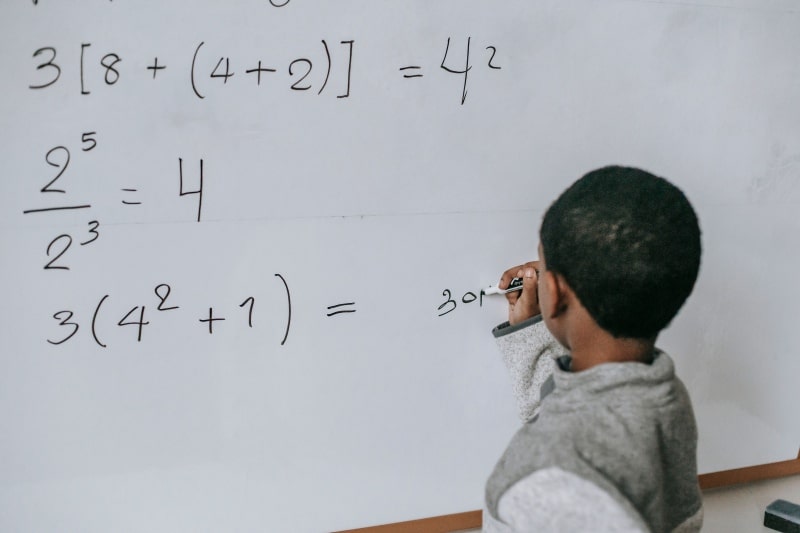
Have you ever seen an inquisitive eight-year-old throw away, in one afternoon, years of perceived failures by deciding they are “just not a math person”?
It happens fast. And it tends to stick.
Children don’t fall out of love with science because science is difficult. They fall out of love because at some point they conclude that they aren’t the kind of person who does science. That mindset develops long before choosing a college major.
The good news?
Confidence is something you develop. And the people around a child shape it more than they realize.
Why STEM Confidence Fades So Early?
Here’s something that catches most parents off guard…
Children aren’t normally taught out of ability. They are taught out of confidence. Confidence in girls when it comes to math and science plummets from 5th to 12th grade. But their grades don’t show that decline.
Read that again. The grades hold steady. The belief falls apart.
And that lack of confidence is growing. Only 59% of girls believe they’re good at math and science, down from 73% in 2017. In less than a decade, that is a serious loss of confidence.
That gap matters more than it might seem. Confidence determines whether a student enrolls in the advanced science course, persists through a challenging calculus module, or ultimately pursues a bachelor’s degree in biology rather than silently switching to something that feels more comfortable. If you think you’re bad at science, you won’t do science. And not doing science looks a lot like not being good at science.
It’s no wonder why elementary school matters so much. Every one of the STEM degree programs your teen could apply to in years to come is built upon a choice they made about themselves back in elementary school. Pursuing a bachelor’s degree in biology, majoring in chemistry, following an engineering track… none of that will seem possible to a student who believes the door is already closed for them.
In the meantime, the work keeps coming. Between 2024 and 2034, computer and mathematical jobs will grow by 10.1%, more than three times faster than the overall economy.
The demand is there. The confidence isn’t.
What Quietly Destroys STEM Confidence?
Confidence rarely gets destroyed in one big moment. It gets chipped away.
Language is the worst offender. Adults want to reassure a child by saying “I was horrible at math too.” But what the kid hears is: that’s genetic, and this family doesn’t have it.
Here are the habits that do the most damage:
- Praising results (“you’re so smart”) instead of effort
- Treating wrong answers as failures rather than information
- Rushing in to rescue a child the second they get stuck
- Talking about math and science as a personality type
Did you notice something about that list? None of them had anything to do with ability.
Kids are great listeners. They hear inflection, sighs and off-hand remarks way more than they learn about fractions. Girls who are confident are 20% more likely to be interested in STEM careers. That tells you that confidence comes before interest. Interest does not come before confidence.
What Parents Can Do At Home?
You don’t have to have a background in science. You don’t have to purchase costly supplies. All you need is a slightly different way of thinking.
Change How You Talk About Struggle
Struggle needs to have its resume rewritten in your home. It currently says “Here I am to remind you that you’re failing.” It should say “Here I am to teach you something new.”
When a child tells you something is too hard, the useful reply is not “let me show you.” It is “what have you tried so far?” That single question gives them back the thinking and communicates that you think they can solve it.
Secondly, ditch “I’m bad at math.” Just kill that thought dead. It allows a kid to give up before they begin.
Make Science Part Of Normal Life
Confidence grows through repeated, low-stakes exposure. Not through pressure.
Simple things work best:
- Cooking together and talking about why food changes when it’s heated
- Letting them take apart a broken appliance
- Growing something from seed and tracking it week by week
- Asking “why do you think that happened?” instead of handing over the answer
None of that looks like school. School is the problem. When science lives in the kitchen and backyard it stops being “a subject you can be bad at” and just becomes something you do.
Show Them Real People
Children don’t aspire to have careers they’ve never seen a person doing. Field trips to museums, science channels on YouTube, a family friend in the lab — it all helps a kid envision themselves in that position.
Why does that picture matter later? Students who know someone who works as a biologist are much more likely to see earning a bachelor’s degree in biology as a possibility.
What Teachers Can Do In The Classroom?
Teachers have more pressure here because that’s where kids measure themselves against others.
The quickest solution is to alter what gets rewarded. If speed is rewarded, most of the class will learn that they are slow. Reward persistence and logic instead, and many more students will feel competent.
Small classroom shifts that make a real difference:
- Ask students to explain their thinking, not just their answer
- Use mistakes as teaching material instead of something to correct and move past
- Rotate group roles so the same kids aren’t always leading
- Call on quiet students with questions you know they can handle
Another challenge with cold calling is the embarrassment factor. Publicly messing up in front of thirty students is rough. Allowing time to think (or a minute to confer with a partner) before sharing answers eliminates most of that anxiety.
Turning Early Confidence Into A Career Path
When students pick their majors, the serious work has either already been accomplished or already failed.
A kid who’s heard for ten years that struggle = learning will see organic chemistry and think “this is going to require some effort”. A kid who’s been told they’re just not a science person will look at that same class and think “this isn’t my thing”.
Same course. Same brain. Completely different outcome.
The confidence gained at age eight is what allows an 18-year-old to believe they can survive an intense program.
Bringing It All Together
STEM confidence is not an innate ability children are born with. It is built from hundreds of subtle exchanges with adults who either welcomed them in or subtly shut them out.
To quickly recap:
- Confidence drops long before ability does
- The language adults use matters more than the curriculum
- Struggle should feel normal, not shameful
- Exposure beats pressure every single time
- Classrooms should reward thinking, not speed
Start early. Stay consistent. And watch what a child decides they’re capable of.
