


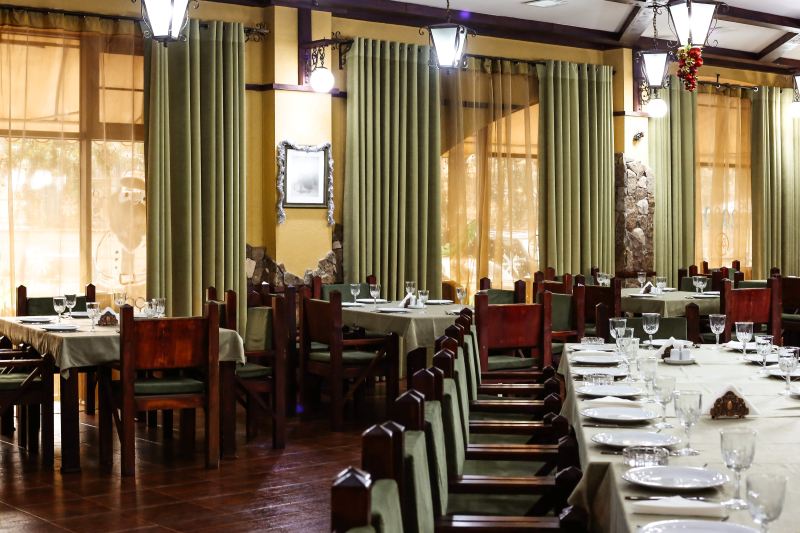
A couple slides into a corner table on a Friday night, orders a second glass before the entrees arrive, and stays an hour past the point most people would have asked for the check. They will leave saying the food was wonderful, the service warm, and the night exactly what they needed. None of that is a lie. But none of it is the whole story either.
What kept them in their seats was a set of choices nobody at the table could name. The space between their table and the next one. The way the room swallowed the clatter from the kitchen instead of throwing it back at them. The give in the seat cushion lets them forget they were sitting at all. Good restaurant design works precisely because it never announces itself. The guest feels everything and notices nothing.
The Sound a Room Makes Before Anyone Speaks
Walk into a dining room, and your ears decide things your conscious mind has not caught up to yet. Hard floors, bare walls, and a high ceiling produce a bright, ringing space where every fork and every laugh bounces back at full volume. Soft floors, upholstered seating, and absorptive surfaces create a room that gently holds a conversation.
Noise is one of the loudest complaints diners make, often ranking second only to poor service. The reason it lands so hard is physical. In a hard room, people instinctively raise their voices to be heard over their neighbors, and those neighbors raise theirs in return. The whole room climbs in volume together, a feedback loop that nobody chose and everybody suffers.
A room treated to absorb sound breaks that loop. Diners can talk at a normal level even when tables sit close, which is why thoughtful operators treat their surfaces before they squeeze in another four-top. The study of how sound behaves in a built space is a real discipline, and acoustics explains why two rooms with identical menus can feel like different planets.
The Invisible Bubble Around Every Table
People carry an unspoken sense of how much space belongs to them, and they instantly recognize a violation of it. Seat two strangers too close and both will sit stiffly, eat faster, and leave sooner, none of them able to say why. Give them a comfortable buffer and they settle.
Layout guides tend to budget between 12 and 15 square feet per seat for a full-service dining room, more for fine dining, and less for a counter-driven fast-casual room. Those numbers are not arbitrary. They encode decades of watching how humans behave when their territory is respected or crowded. The science of personal space has a name, and proxemics is the quiet logic behind why one room feels generous, and another feels like a waiting line.
What the Body Knows About a Chair
A guest sits down, and within seconds, the chair has already made an argument. Too upright and they feel rushed. Too soft and deep, and they sink, then struggle. The seat that disappears under a diner is the one that has been measured against the human body rather than a sketch.
- Seat height that lets feet rest flat, usually around eighteen inches.
- A backrest angle that supports the lower spine without forcing a slump.
- Enough seat depth to hold the thigh, not so much that the edge cuts behind the knee.
- Arm height that meets the table without pinning the elbows.
Get these right and the guest forgets the chair entirely, which is exactly the point. A seat that asks nothing of the body buys the kitchen time and buys the check a few more lines.
The Light You Eat By
Lighting changes the rules of the meal before a single plate lands. Bright, even, cool light signals speed and energy, which is why quick-service rooms lean into it to keep tables moving. Low, warm light tells the body to slow down, settle in, and order another round.
The same plate of food looks more appetizing under warm tones and slightly dim conditions, and the same guest behaves differently under each. None of this is a trick played on the diner. It is an honest match between the mood a room promises and the experience it actually delivers.
The Math Hiding Under the Mood
Every one of these invisible choices eventually shows up on a spreadsheet. A room that holds conversation keeps guests longer and lifts the average check. Seating that respects personal space turns first-timers into regulars. Comfortable chairs extend dwell time without anyone feeling pushed, and longer, pleasant visits tend to mean larger orders.
The reverse is just as true and far more expensive. A loud, cramped, hard-seated room can serve excellent food and still lose customers who cannot explain why they never came back. They felt something off and trusted the feeling. Design that ignores the senses is design that quietly underperforms its own menu.
Why the Best Rooms Keep Their Secrets
The strange reward of doing this well is that nobody will ever thank you for it. No guest leaves a review praising your reverberation time or seat depth. The acoustics, the spacing, the cushion, and the light all do their work below the surface of attention, and that anonymity is the proof they succeeded.
So the operators who win are the ones willing to invest in things their guests will never see on the bill. They tune the room the way a musician tunes an instrument before the audience arrives, knowing the audience will only ever hear the song. The feeling is the whole product, and it is built quietly out of decisions made long before the doors opened.
